Ways of Europe: Same Journey, Next Chapter. From Rights to Reality
After two years of activities across Europe, Ways of Europe brings together young people’s voices, experiences and proposals in an exhibition exploring the gap between the rights enshrined in the EU Charter of Fundamental Rights and the realities of everyday life
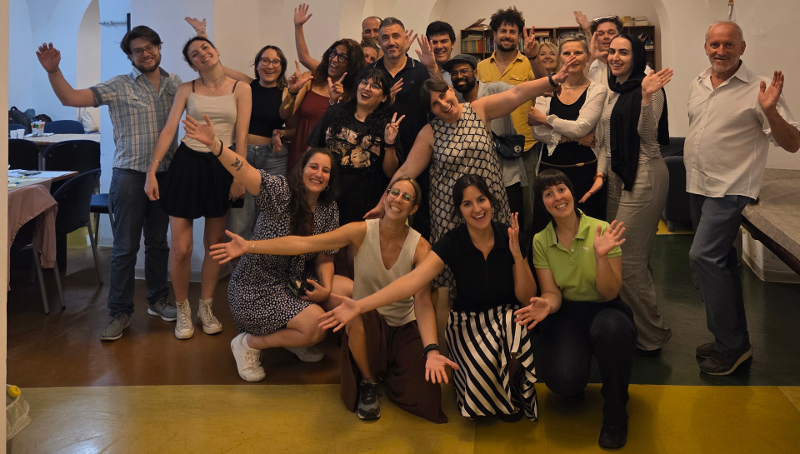
What kind of Europe do we want? And above all, how closely does the Europe we live in reflect the principles and rights it is founded upon? These questions inspired the exhibition Ways of Europe: Same Journey, Next Chapter, presented to the public in Brussels on 13 October and developed from the experiences, discussions and proposals gathered over the two years of the project.
The European Union’s Charter of Fundamental Rights, also known as the Nice Charter, is one of its key frameworks for the protection of fundamental rights. The Charter affirms the values of dignity, freedom, equality, solidarity, citizenship and justice. It protects human dignity and the right to asylum, guarantees freedom of assembly and association, and prohibits all forms of discrimination. Yet behind every article are people, struggles and achievements. And formally recognising a right does not necessarily mean that it is fully realised in practice.
It is precisely this gap between principles and everyday life that has shaped the work of Ways of Europe. Over the past two years, young people, associations, educators, activists and local communities have come together. On park benches, in school classrooms and community spaces, from Brussels to Lampedusa, from Calais to Barcelona, from Budapest to Turin, participants have worked together to answer a common question: what do European rights actually mean today? The articles of the Charter featured in the exhibition emerged from the experiences and encounters developed across the different project locations. Each of them highlights the relationship between what Europe commits to guaranteeing and the challenges that still remain. This is why each panel brings together a violation of a right and possible responses: the obstacles that exist and the paths that can be taken to overcome them.
The exhibition begins with human dignity, a principle that runs through all other rights: a map that brings together, for each city, a voice, a violation and a response. When it comes to the right to asylum, Lampedusa and Calais tell the stories of two borders at the edges of Europe: one where people arrive, the other where they wait to move on. Two different contexts that reveal the distance that can still exist between the rights enshrined in the Charter and the lived experience of those seeking protection.
When we talk about freedom of assembly and association, it becomes clear that this freedom concerns not only individuals, but also the possibility of organising, participating in public life and expressing dissent. In Brussels, young people are calling for meaningful and effective forms of participation. In Lampedusa and Calais, organisations supporting migrants operate in complex environments, often with limited resources. In Budapest, the focus is on the ability of associations and citizens to act and express themselves freely; in Turin, on the right to protest and the way dissent is represented in the public sphere. Protecting individual and collective freedoms is an essential condition for a democratic society.
Non-discrimination also takes on a concrete meaning when we move from statements of principle to everyday experiences. In Barcelona, through its work with Roma communities, the project explored forms of discrimination that are often normalised or difficult to recognise: from segregation in education and housing to arbitrary identity checks, as well as stereotypes embedded in language and media representation. Tackling discrimination, therefore, is not only about having appropriate legal frameworks in place. It also means creating spaces for dialogue and listening, recognising our own biases, and enabling those directly affected to tell their own stories in their own voices.
What has emerged from this journey is not a list of definitive solutions, but a shared vision of Europe: a Europe where security is rooted in the protection of rights rather than fear; where differences do not translate into inequalities; where participation is meaningful rather than merely symbolic; and where the media, institutions and citizens are aware of the responsibility that comes with the words they use. A Europe where fundamental rights are genuinely accessible to everyone.
Through the exhibition, Ways of Europe therefore aims to revisit the Nice Charter from the perspective of those who experience Europe in their everyday lives, connecting the rights recognised by the Charter with the contradictions that still exist and, above all, with possible ways to overcome them. This is the meaning behind the title that opens the exhibition, Rights We Make Together: rights cannot be considered secured once and for all; they require participation, protection and shared responsibility.
This is the vision of the European Union that has emerged from our journey. What is yours? Which rights are genuinely guaranteed in your everyday life? Which still face obstacles to their full realisation? And what needs to change to help build the Europe we want?
Photogallery